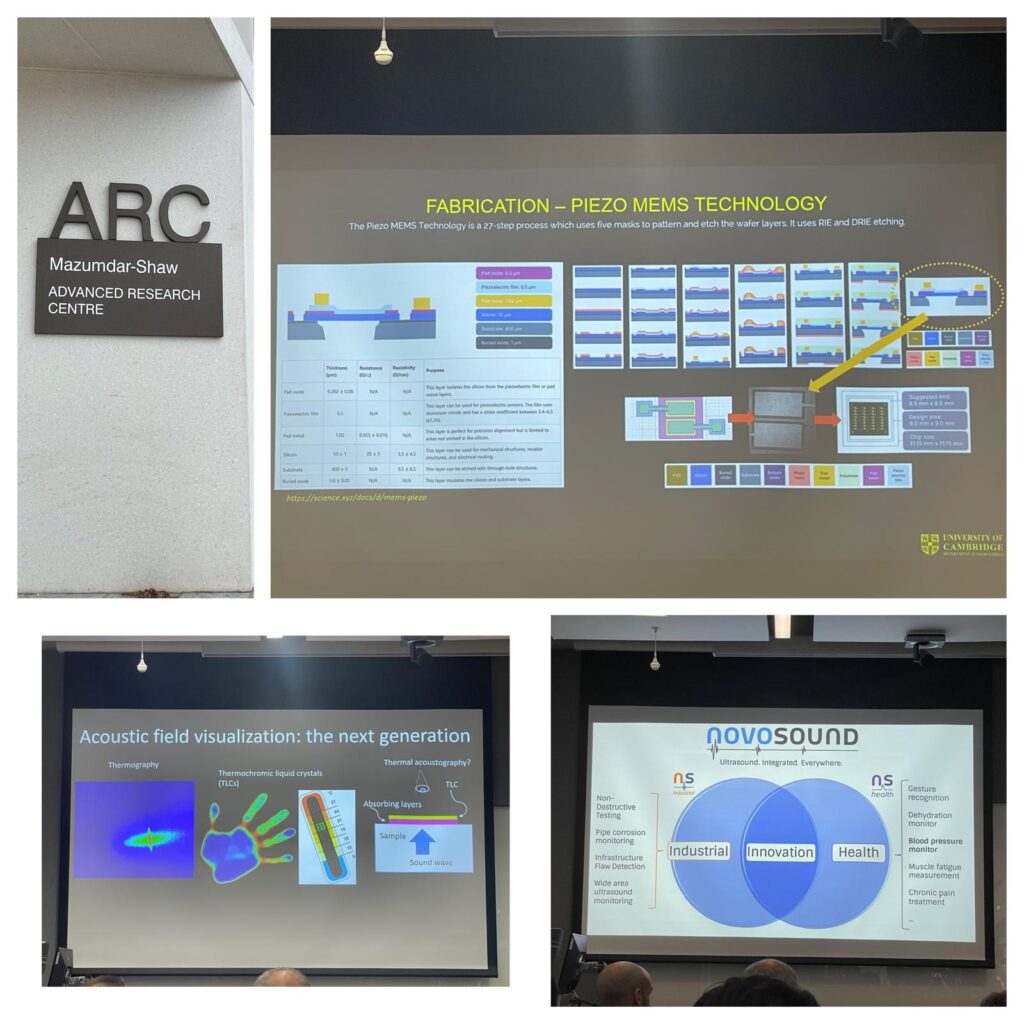
The UK Microacoustics Symposium, held on 24 October 2025 at the University of Glasgow’s Advanced Research Centre, brought together researchers from across the UK to explore the breadth, innovation, and interdisciplinary nature of microacoustics research. Organised under the EPSRC UK Microsystems Network, the event highlighted how microscale acoustics continues to drive advances across sensing, fabrication, fluidics, and biomedical engineering.
Talks from leading UK researchers demonstrated the diversity and impact of current work. Professor Martin Lavery’s group (University of Glasgow) showcased acoustic trapping for 3D printing in mid-air, while Professor Rachel Edwards (University of Warwick) presented new methods for acoustic characterisation of stress in MEMS devices and liquid crystal-based imaging of acoustic fields, achieving imaging speeds faster than conventional scanning techniques. Professor Ruchi Gupta (University of Birmingham) discussed advances in acoustic tweezing for droplet-based chemical reactions, enabling precise control of microscale reaction environments.
Collaborative research between Professor Julien Reboud (University of Glasgow) and Dr Anne Bernassau (Heriot-Watt University) explored the integration of acoustics and microfluidics for cell manipulation and diagnostic applications. In parallel, Jeremy Hawkes (Acoustic Machines) delivered a live demonstration of a microfluidic platform for visualising and controlling acoustic flows, illustrating how commercial innovation is advancing microscale actuation technologies.
Biomedical applications were another central theme. The MeLab (Dr Hadi Heidari, University of Glasgow) presented work on magnetostrictive implantable systems, while Dr Kimia Witte (University of Glasgow) described the use of surface acoustic wave devices for mechanostimulation of bone growth. Professor Ashwin Seshia’s group (University of Cambridge) introduced developments in piezoMEMS for photoacoustic imaging, showcasing the potential of microscale acoustics for next-generation diagnostic tools.
The event also featured strong industrial engagement. Novosound shared their progress on flexible piezoelectric arrays for wearable blood pressure monitoring, while Nebu~Flow presented their acoustic nebuliser technology, highlighting real-world translation of microacoustics into healthcare. Kelvin Nanotechnology showcased their microfabrication and nanolithography capabilities, underlining the importance of advanced UK infrastructure in supporting research and commercialisation.
The day included a thought-provoking perspective from Dr Karl Toland (University of Glasgow), who reflected on what microacoustics could learn from astrophysics, particularly in applying complex system modelling and data interpretation methods to acoustic systems.
The symposium underscored the strength, creativity, and collaborative spirit of the UK’s microacoustics community, from fundamental research to commercial translation.
Special thanks go to Professor Richard Fu (Northumbria University), who leads the Microacoustics Strategic Interest Group within the UK Microsystems Network, and to Dr Mary Dysko, Professor Sandy Cochran, and Professor Julien Reboud for their invaluable contributions to hosting and shaping the event.