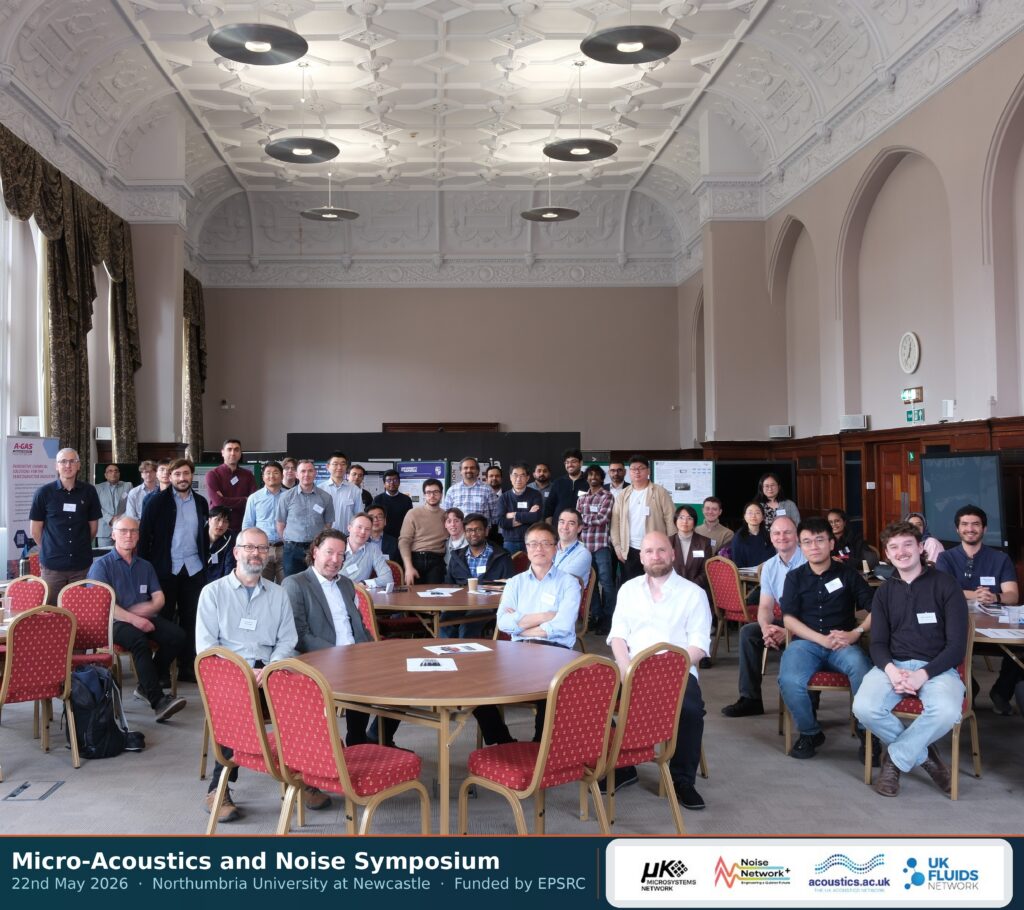
On the 22nd of May 2026, the Micro-Acoustics and Noise Symposium was successfully held in the Great Hall at the Sutherland Building, Northumbria University, Newcastle. The event brought together more than 60 attendees, including academics, researchers, students, industry representatives and other stakeholders, for a full day of talks, demonstrations and networking.The symposium was sponsored by the UK Microsystems Network through EPSRC, with additional support from the UK Acoustics Network Plus, the Noise Network Plus and the UK Fluids Network. It was chaired by Prof. Richard Fu, Associate Prof. Barry Gallacher and Prof. Bruce Drinkwater.
The programme explored the latest advances across acoustics, sensors, acoustofluidics and ultrasonics, while also taking on some of the grand challenges around vibration and noise in the UK. Throughout the day, speakers returned to a shared theme: the opportunities created by micro-acoustic sensors and actuators and other emerging technologies, with applications spanning engineering, healthcare and sustainability.The format mixed keynote talks, technical presentations, technology demonstrations and poster sessions, leaving plenty of room for networking and collaboration. Attendees also had the chance to tour Northumbria University’s micro- and nano-fabrication facilities and thin-film materials laboratory.
The morning, chaired by Prof. Hamdi Torun (Northumbria University), opened with a welcome from Prof. Richard Fu and moved into a strong run of keynotes. Prof. Jeff Neasham (Newcastle University) spoke on underwater acoustic monitoring and IoT, followed by Dr. Kristian Groom (University of Sheffield) on bio-inspired acoustic sensors for monitoring buried pipe infrastructure, and Prof. Krishna Coimbatore Balram (University of Bristol) on building efficient microwave acoustic interfaces to nanoscale systems.
A second morning session, chaired by Prof. Bruce Drinkwater (University of Bristol), featured Associate Prof. Barry Gallacher (Newcastle University) on polar-form Rayleigh wave resonators, Dr. Andrew Reid (University of Strathclyde) on insect-inspired mechanical processing of acoustic cues, Dr. Freddy Sarathchandra (Enstic) on insect acoustics in the field, and Mohammad Zaid (University of Cambridge) on AI-driven piezoelectric micromachined ultrasound transducers.
After lunch, posters and demonstrations, plus an optional tour of the Northumbria research facilities, the afternoon turned to acoustic trapping and acoustofluidics. Prof. Bruce Drinkwater (University of Bristol) presented on optimal acoustic trapping of large and complex objects, Prof. Thomas Franke (University of Glasgow) on acoustofluidics for cell manipulation and droplet microfluidics, and Prof. Liying Zhang (Nanjing Medical University) on acoustofluidic-assisted point-of-care testing.
The closing session, chaired by Prof. Thomas Franke, focused on modelling: Dr. Baxin Chen (Heriot-Watt University) on simulating the impact of surface acoustic waves on droplets using CFD and LBM, Dr. Mehdi Biroun (Dyson Institute) on numerical and experimental analysis of droplet impact control by acoustic waves, and Dr. Pradipta Das (University of Bristol) on multiscale modelling of the acoustothermal effect and droplet acoustofluidics.
Our thanks go to everyone who took part: the speakers, session chairs, poster presenters and all who attended and made the day such a lively and collaborative one. We are also grateful to our sponsors and supporting networks, and to Northumbria University for hosting the symposium and opening up its fabrication and materials facilities to visitors.The strong turnout and breadth of work on show underline the growing momentum in micro-acoustics across the UK, and we look forward to building on these connections in the future.